Other than keeping score, math and squash aren’t a natural combination. One is a classroom staple that makes plenty of teenagers groan. The other is a fast, sweaty racquet sport played between four walls, and it rarely shows up in Nova Scotia high schools.
But James Wiseman has found a way to combine the two for his students.
The first time the math teacher at Horton High, near Wolfville, Nova Scotia, brought his students to the local squash courts, he sat them down and taught a math class beside the glass, and then broke out racquets.
“They sort of fell in love with it right there, and it took off,” says James.
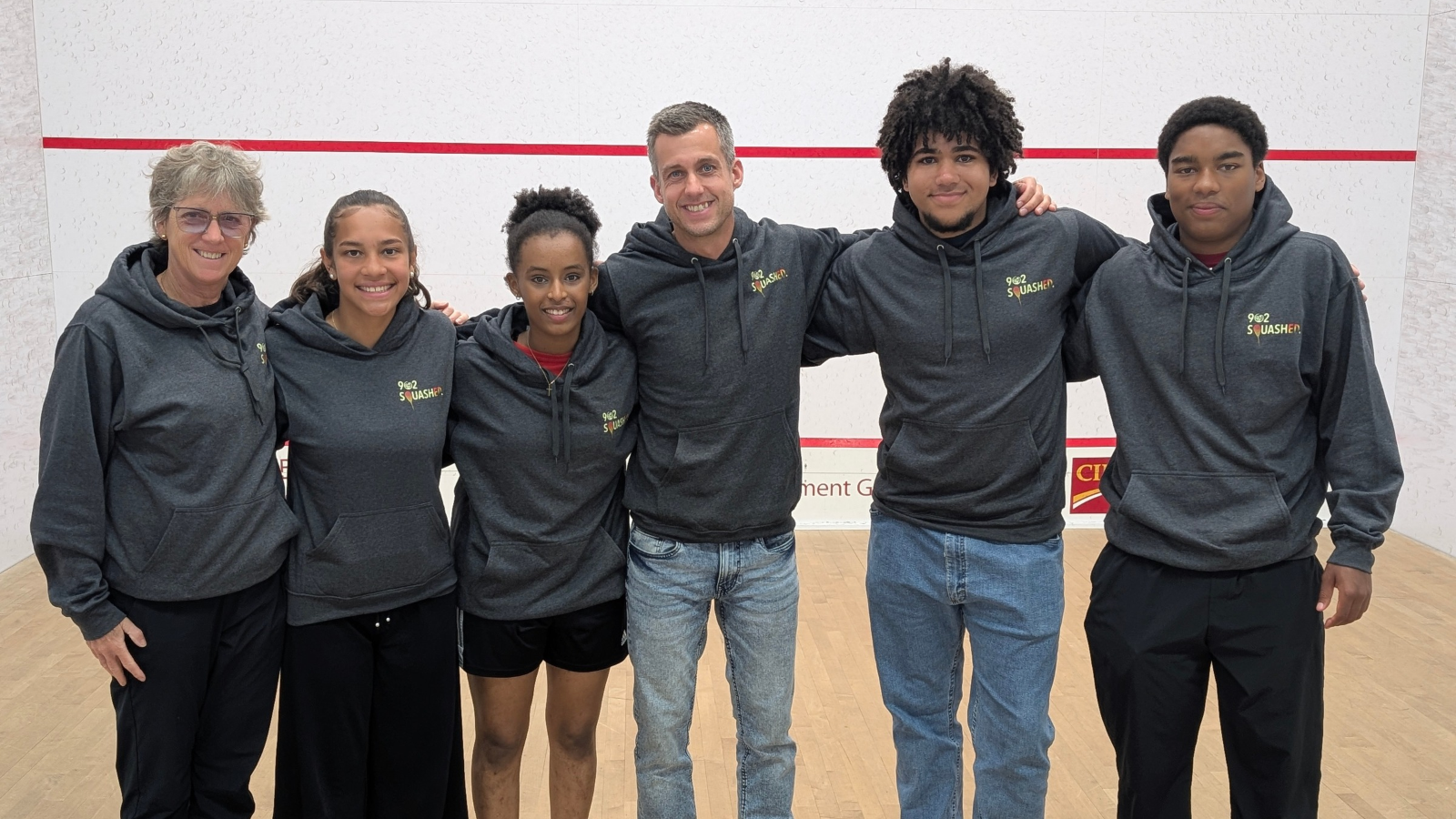
That was the start of 902SquashEd, a not-for-profit program that has put dozens of students of African descent on the squash court, sending them to tournaments across the Maritimes and Ontario in the process.
James is the lead math teacher in the school’s Africentric cohort, serving students in grades 10 through 12.
He’s also one of the best squash players in the province, ranking second among all men in Nova Scotia, and plays nearly every day.
James was sharing two of his passions with his students and discovering how one could strengthen the other.
“It definitely helped me make a connection with the kids,” he says. “It led to trust in the classroom. I really wanted them to feel okay in taking risks when it came to learning math in the classroom and trying a new sport. Incorporating squash became a great method.”
What started with five students quickly grew to 25. That’s when Janet MacLeod, a retired teacher and national-level coach, came aboard. The pair realized the program had outgrown one teacher taking kids to the Kings County squash courts.
“We were like, ‘this is growing,’” says James. “We’ve got to make this a proper entity.”
They registered 902SquashEd as a not-for-profit, brought parents on board and built the program into what it is today.
Five years after James conceived the idea, 902SquashEd is now at the centre of a partnership involving Horton’s Africentric cohort and the Kings County Squash Club. The plan is to expand into other schools for students of African descent.
The program blends court time with academic support and mentorship, built on the belief that sport can sharpen the mind as much as the body.
At its core, 902SquashEd breaks down barriers. Equipment, travel and registration fees are some of the biggest reasons kids never try a sport like squash. So the program covers it all, right down to tournament hotels, meals and entry fees.
Sport Nova Scotia’s EDIA funding helped get the program started, covering early investments in racquets, protective eyewear, sneakers and other essentials.
While the search for grants never stops, for the players, the support changes everything.
“902SquashEd allowed me to play a sport without financial stress and build lifelong friendships,” says Julia Akao.
Last December, Julia travelled to Toronto for the Canadian Junior Open, where she took on some of the country’s top junior players.
“The entire trip was fully funded for my three other teammates and me,” she says.
Just like Julia did, most Grade 10 students arrive with no squash background. Some are now chasing Canada Games spots. Others have stepped into leadership roles. Over the last two years, 902SquashEd has trained and certified its top players as coaches through a Squash Canada program.
Julia and fellow player Alemnesh Sanche-Spencer got their first taste of coaching when Janet MacLeod let them pilot a program together.
“It was a great coaching experience that taught me patience and adapting to different skill levels of players,” says Julia.
For Alemnesh, the coaches who brought her along mattered as much as the game itself.
“They gave me a chance to not only thrive in this sport, but to be able to diversify the sport,” she says.
James no longer needs to convince students to try squash. Siblings are signing up, parents are showing up to watch and when he introduced squash to his new Grade 10 class this fall, every student signed on.
“There’s no chasing,” he says. “There’s no convincing. They know they want to be a part of it.”
Some of those graduates haven’t strayed far from the court. Many tournaments are held at Saint Mary’s University (SMU) in Halifax, and several 902SquashEd alumni have enrolled there, drawn by the familiar courts and squash community, where everyone seems to know each other.
Victor Onyebuchi is one of them. He’s still competing and working to climb the rankings, and he’s leading the push to grow the sport at SMU by starting a squash club. With help from the Jesters Club, Victor and his fellow players organized a successful university tournament with Dalhousie and the University of Prince Edward Island.
“902SquashEd has had a tremendous impact on my life and still does today,” says Victor. “I’ve been able to travel and compete across the Maritimes and make meaningful connections with people. The program has not only helped shape me as an athlete but also the person I aspire to be.”
Meanwhile, Alemnesh is one of SMU’s newest arrivals. She started this fall, majoring in criminology with plans to move into social work, and she’s already on the SMU courts every week.
“I got welcomed into the Halifax squash community, which I would never have done if it wasn’t for 902SquashEd,” she says.
Julia now plays for the Acadia Axewomen soccer team. But she’s still bringing new players to the squash courts, hoping they’ll catch the bug once soccer season winds down this winter.
“I can’t imagine how different life would have been if I hadn’t gotten pushed out of my comfort zone playing an individual sport like squash,” she says. “It’s changed me as a player and as a person.”
For James, that’s the beauty of squash. It doesn’t end when high school does.
“It’s a lifelong sport,” he says. “I see students now that have graduated that are competing at a very high level.”
So, what does math have to do with squash?
Both require patience, practice and the courage to take risks. For James and his students, they’ve also become the foundation of a community that extends well beyond the classroom and the court.