Ocean Le’s eyes light up the moment he starts talking about tennis. That’s because he’s talking about something much bigger than the game.
“It’s really about community belonging,” says Ocean, who has been instrumental in establishing Cape Breton’s newcomer support network, and a new Try Tennis program for beginners and youth.
Moving to Cape Breton during COVID-19, Ocean worked in the Connector Program at the Cape Breton Partnership, matching newcomers and local graduates with professional networks across the island. He was also one of the first faces to help create the Multicultural Association of Cape Breton.
While he continues to play a leading role with the association and connecting people, today Ocean serves as a local healthcare navigator for Inverness County.
As a certified tennis instructor, Ocean has also helped unite growth in the game across Cape Breton with an inclusive foundation.
By developing the region’s Try Tennis program, he’s built a united partnership between the Multicultural Association of Cape Breton, the Racket and Paddle Association of Cape Breton, Tennis Nova Scotia, the Cape Breton Regional Municipality and Inverness County Recreation.
With Equity, Diversity, Inclusion and Accessibility (EDIA) funding support from Sport Nova Scotia, the program was built to provide newcomers with a free, low-barrier introduction to tennis with equipment, coaching and community in place.
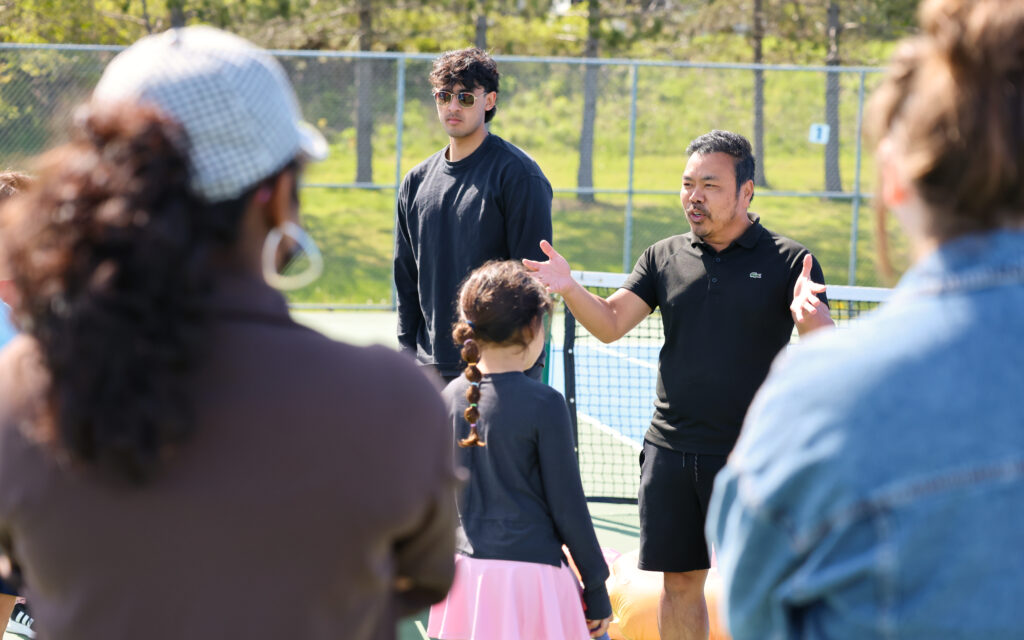
The seeds of the program go back to Ocean’s own experience as a newcomer.
Originally from Vietnam, Ocean’s family ended up in a refugee camp in Thailand, before a church sponsorship took them to Brandon, Manitoba. The family eventually made their way to Toronto, as Ocean’s father looked to establish work. Throughout his journey, Le grew up playing tennis and developed a strong network of tennis-playing friends from around the world.
When he began coaching tennis in Cape Breton, Ocean immediately saw the opportunity to use the game as a welcoming step into the community for other international newcomers.
The insight was simple. Tennis could be the hook, with community connection serving as the broader outcome.
“Not only can we teach tennis, but it’s a great way for the kids to make friends,” Ocean explains. “And it’s also a great way for the parents to make friends and find emotional support.”
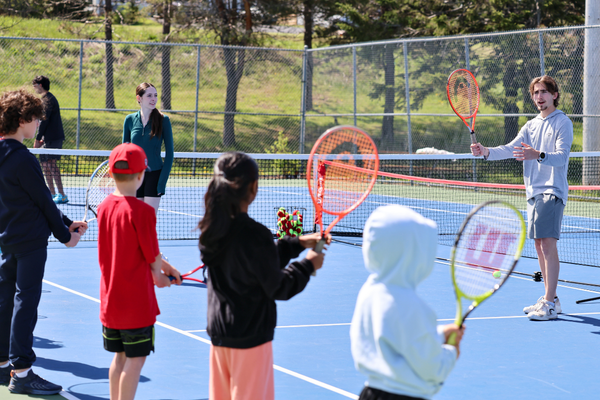
With coaches and volunteers who speak multiple languages, the program removes one of the biggest barriers newcomer families tend to face, which is simply not knowing where or how to connect with the community they’re living in.
The response to the programming has been outstanding, with expectations already exceeded.
In its first month alone (June 2026) the Try Tennis Cape Breton had roughly 65 participants, ages five and up. It was originally planned as a single-month pilot, but the early success, paired with continued backing from Sport Nova Scotia, extended the program through July and August.
The program runs across three regional locations: the Sydney River Tennis Club and the Cromarty Tennis Club in Sydney, the Glace Bay Tennis Club at Elizabeth Park and the courts in Inverness County. Sessions welcome participants from ages five through adult, and organizers deliberately schedule parent and youth sessions at the same time, so families can learn and later play together on their own.
“We played tennis back home (in Columbia), but when we came here it was kind of hard to find a place to play, especially for the kids,” says Ana Maria Gutierrez, who moved to Sydney two years ago with her husband and two children to take her MBA at Cape Breton University. “Back home, our kids were already in competition, so they were high performance, even though they were very young. The four of us have been playing for a while, and we love the sport. Sports like tennis are beneficial in every sense, for people any age, especially for kids. And, of course, it’s also great for newcomers. It’s a way to connect with the local community in the places like Cape Breton. It’s been a lot of fun.”
Equipment has been central to making the program successfully accessible.
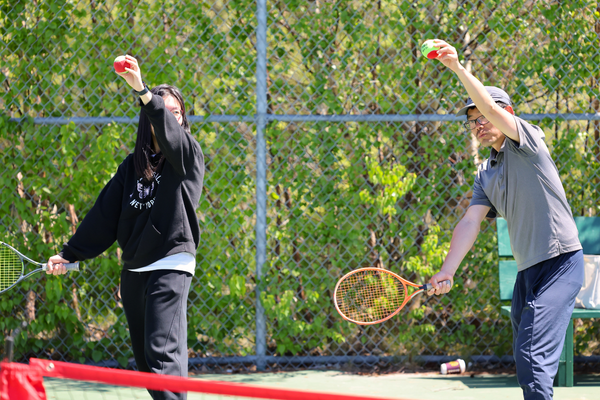
Sport Nova Scotia funding has allowed organizers to purchase a full range of youth and adult rackets, tennis balls, ball baskets and mini nets. Newcomer families can drop by anytime to borrow rackets and balls and play on their own.
“You sort of see the courts being used more, especially in the evening times, with the parents and the kids coming out,” says Ocean. “Beyond the courts themselves, families are exchanging phone numbers for playdates, and newcomer participants are beginning to explore competitive tennis pathways, including at the Nova Scotia Open. The hope is that someday they can represent Cape Breton at the provincial level.” Once newcomers complete the Try Tennis program, they are connected to the Racket and Paddle Association, providing access to community programs and competitive opportunities.
Organizers are already planning local tournaments in both Sydney River and Glace Bay, along with participation in the Cape Breton Open in Cromarty and potential exhibition matches. Sessions are also expanding from one hour to two, with the added time devoted to strategy and technical training beyond the fundamentals.
Longer term, the vision incudes a five-year plan to further activation across the region and eventually build a tennis facility. Developing more players into certified coaches is another aspect that needs attention through time.
But for an instructor like Ocean, the opportunity to serve up newcomer opportunities through tennis goes beyond the game; it’s about building community.
“A lot of times our goal is hopefully they can get connected, so they can find future opportunities for employment, making new friends and just growing roots within the community,” he says. “That’s very important for newcomer success. And of course, we want people to fall in love with tennis and have the sport for life.”
In Cape Breton, that kind of belonging and social success can all start with something as simple as a racket, a ball and an open court.