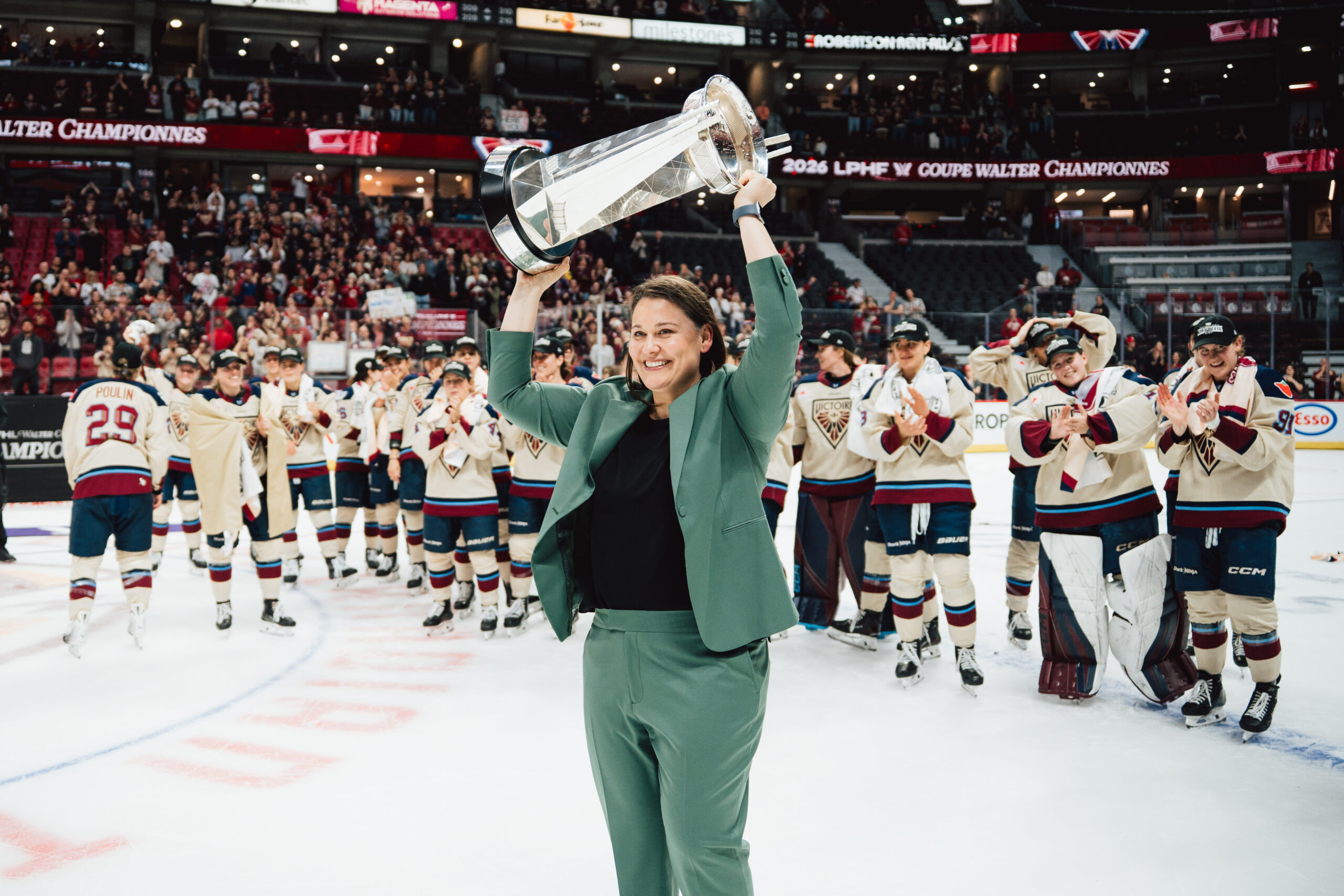
Kori Cheverie has been in rinks around the world: representing Nova Scotia at the Canada Games as a teen, captaining Saint Mary’s University and on Canada’s Olympic bench in Milano Cortina. But this summer, the rink that mattered most was in New Glasgow, at the Pictou County Wellness Centre, where she walked in carrying the PWHL’s Walter Cup.
The visit was more than a homecoming. It was a small Nova Scotia community claiming another face of hockey history as its own. Local NHL stars of the past, like Jon Sim and Colin White, brought home the Stanley Cup. But Cheverie, fittingly, represents the potential for a more accessible era in hockey.
As head coach of the Montreal Victoire and an assistant with Canada’s Olympic women’s team, Cheverie was fresh off a remarkable stretch: a hard-fought Olympic silver in February, then Montreal’s Walter Cup win in June, making her the first woman to win a PWHL title as head coach.
Back home to decompress, Cheverie found the parade and meet-and-greet that followed was more than civic pageantry.
“Anytime we can bring major trophies home to Nova Scotia, it makes the family, the community, the supporters extremely proud,” she says. “It was awesome to meet a ton of the boys and girls that came through the picture line and see what it meant to them. It’s really important to engage young people, get them involved, and allow them to see what is possible if they continue to dream and stay in sport.”
It’s a full-circle moment that means even more for those who know where it started.
Kori wasn’t a privileged kid on skates. She started hockey at 10, late by the standards of a sport known to consume Canadian kids before they can read. Her mother was raising three children alone while getting a home preschool business off the ground and the family budget didn’t have much room for hockey.
So, Kori struck a deal with her mom: if she could scrape together the cost of equipment, her mom would cover registration. Kori held a yard sale, raised about a hundred dollars and bought a second-hand set of gear from a man in town. Her mother paid the registration fee.
Once Kori hit the ice, she took off.
House league gave way to AA boys’ hockey. Nova Scotia had no U14 or U16 programs for female players at the time, so representing the province as a youth meant trying out for the U18 team, regardless of a girl’s age. That’s how a 13-year-old Kori ended up making a team of mostly 17- and 18-year-olds. Two years later, at 15, she was skating for Team Nova Scotia at the Canada Winter Games under a young coach named Lisa Haley.
“Normally you’re 17 and turning 18 making those teams, and she made it as a much younger player than that,” Lisa recalls. “Even as a 15-year-old on the Canada Games team, she was never overwhelmed by any situation she was in.”
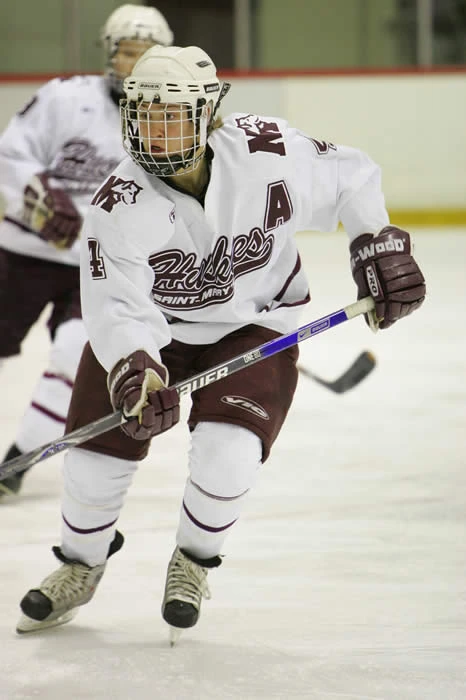
Like many talented young female players of the era, Kori eventually outgrew what the province could offer competitively. She left for Ontario to play at a higher level, before landing back at Saint Mary’s University (SMU) in Halifax—reuniting with Lisa, the first coach of the SMU women’s hockey program.
Over five years at SMU, Kori was named an Atlantic University Sport first-team all-star three times, took home the Huskies’ women’s hockey MVP award and was voted SMU’s female athlete of the year twice. In 2009, she added an international title, winning gold with Canada at the FISU Winter Universiade in Harbin, China.
While Lisa became a hockey mentor, Kori inherited her work ethic from her mother, Janice.
“She has definitely paved the way and set the standard for the type of work ethic that we have in our family,” Kori says.
That work ethic shows up in unexpected places on her coaching resume. She spent university summers working at her mother’s daycare, and when she moved to Toronto in 2010 to chase a pro career, one of her first jobs there was at another daycare. It wasn’t glamorous, but in hindsight, it helped shape a coach now recognized internationally.
“Daycare, that environment, is really about helping raise kids, keeping them safe, teaching them about life in different ways,” Kori says. “I think it’s helped my coaching side in terms of development and empathy and understanding that all kids are different. You have to find a way to connect with them.”
Later, she joined Lisa at Toronto Metropolitan University, working her way from the school’s skate-training program into a full-time assistant coaching role with the men’s team—a first in Canadian university men’s hockey.
Lisa saw the coach in Kori well before she did.
“I never doubted that Kori had a lot of natural leadership abilities,” Lisa says. “She was a significant catalyst in terms of the culture within our team—not just on-ice drive, but the engagement and personality off the ice. Other players were drawn to her and wanted to follow.”
In 2021, Hockey Canada named Kori assistant coach of Canada’s National Men’s Under-18 Team for the IIHF U18 World Championship, where she’d arrived as the first woman to hold a coaching role on a Canadian national men’s team.
And in 2024-25, Kori became the first woman to win the PWHL’s Coach of the Year award. But not every chapter came easy. The 2025-26 championship run followed back-to-back first-round playoff exits, the kind of results that force a coach to question every decision.
“Kori’s never hesitated to dare greatly in any aspect of her career,” says Lisa. “She’s not shy. She was the first female full-time assistant coach in U Sports men’s hockey, and I think she has more firsts and more accomplishments ahead because she has what it takes to get to that next level. She’s not scared to bet on herself or take chances.”
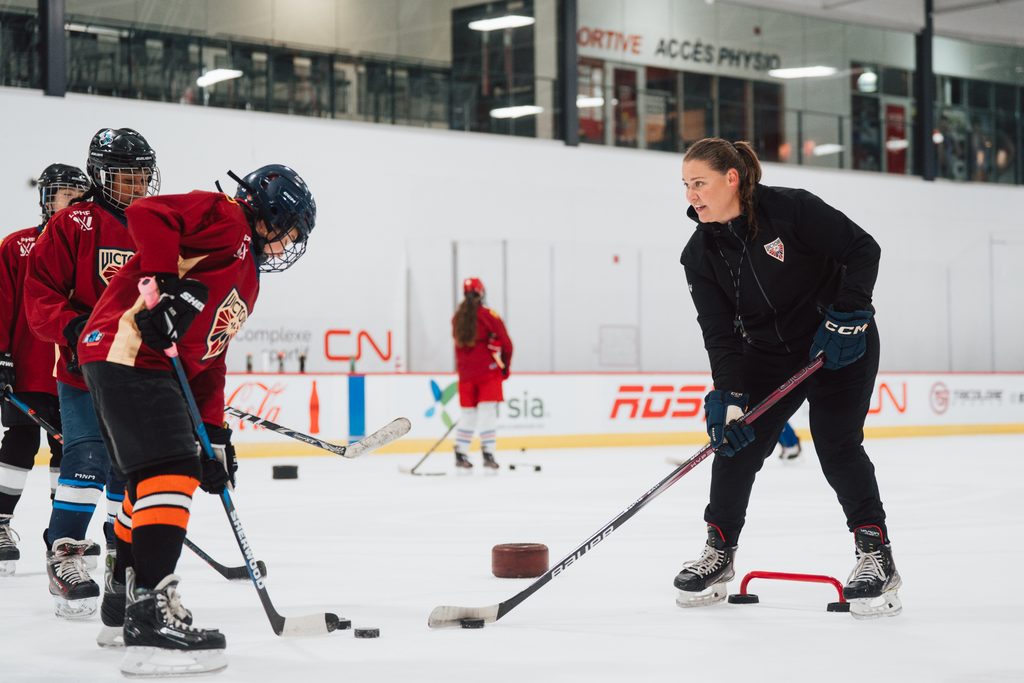
A lot lies ahead, like defending the Walter Cup once PWHL training camps open on November 18. Kori also hopes to see change in hockey’s accessibility for girls.
“We need to have more women playing. That’s the foundational piece that will continue to feed our entire country’s player pool,” she says. “Hockey continues to be an expensive sport, and we need it accessible to more people.”
So what would Kori tell the 10-year-old girl who needs to hold a yard sale just for the chance to play?
“Work ethic, number one, and having fun,” she says. “That’s what I grew up on. My mom wanted me to work hard, and she wanted me to have fun. Those two things often go hand in hand, and they lead to getting better at whatever it is you decide to do. There’s going to be days where it feels like nothing is going right for you. Pushing through those days, knowing that you love what you’re doing, is an important piece of the puzzle.”
For the kids who came through that picture line at the Pictou County Wellness Centre this summer, and for the ones lacing up for the first time this fall, that’s the real takeaway from a coach who once counted on yard-sale dollars just for the chance to play.