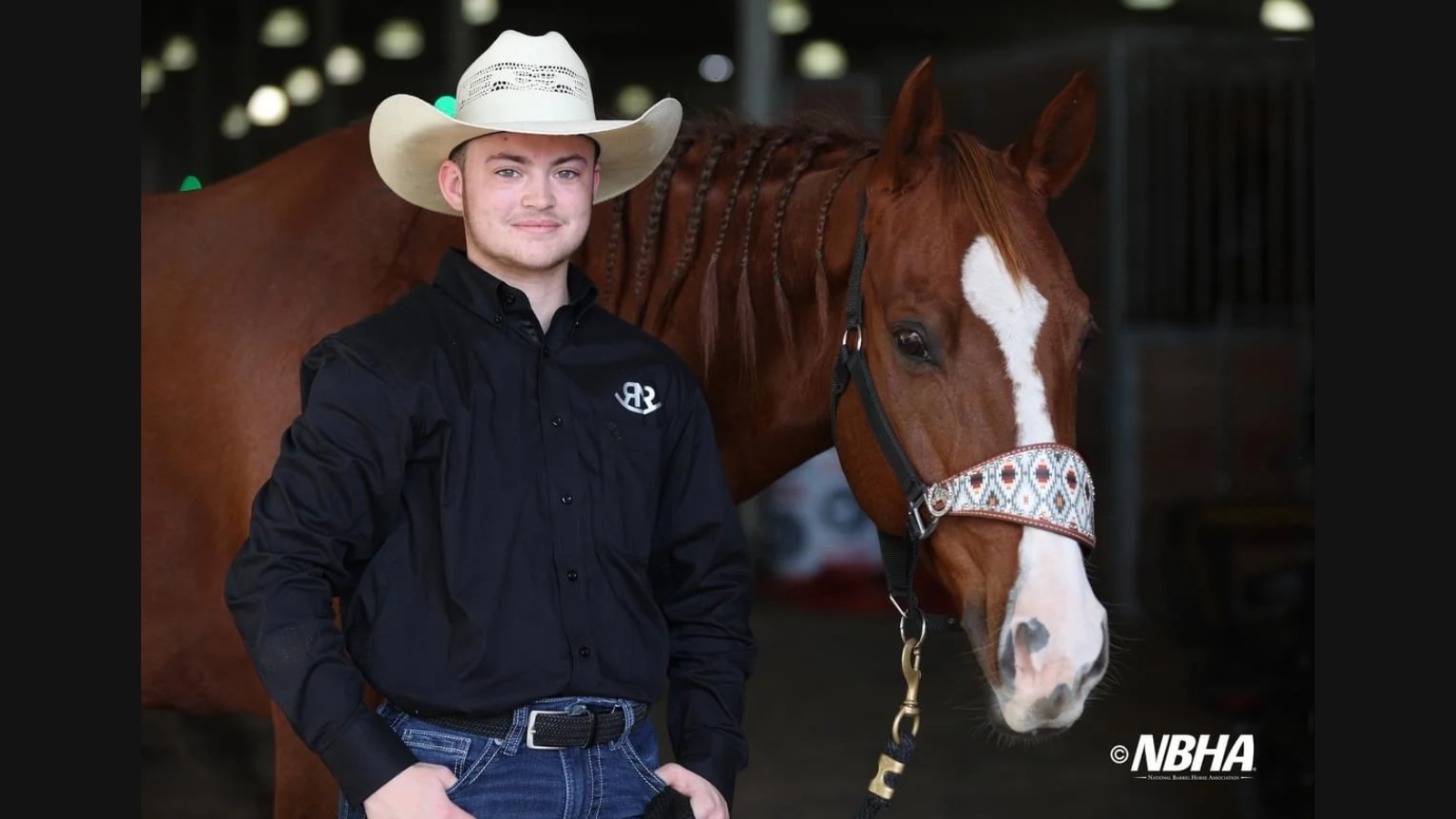
Wentworth, Nova Scotia, barrel racer Ashton Rushton has taken his horse to the world championships in Georgia three times, but he says the learning never stops.
More than 1,000 horses came through the gates for the Open at the National Barrel Horse Association (NBHA) World Championships this fall in Perry, Georgia. It was the biggest field the event had drawn in years. Some of those horses had won more than a million dollars in their careers.
One of them was a 10-year-old Quarter Horse named Eddie, who had made the three-day haul south from Wentworth, Cumberland County, with 23-year-old Ashton.
Ashton and Eddie ran consistently all week but missed the 26-horse final. For a rider from a province without an active NBHA district, just getting there takes a full season of work.
For anyone new to the sport, barrel racing is simple to watch and hard to master. Three barrels are set in a triangle. Horse and rider sprint in, circle each barrel in a cloverleaf pattern, then race home. The clock decides everything and knocking over a barrel adds five seconds.
At the top level, a run can be over in less than 20 seconds, with winners sometimes separated by thousandths of a second.
The NBHA uses a divisional system based on the fastest time recorded. The 1D is for the quickest runs, with each division after covering the next half-second. That gives weekend riders a chance to win money alongside full-time professionals. It also means one blazing run can shift the standings across multiple divisions.
“It all depends on that fastest horse’s time,” Ashton says of what he knew to expect in Georgia. “We just kept falling in between the cracks. We weren’t fast enough for the 3D and we weren’t slow enough for the 4D.”
Ashton doesn’t come from a horse family, but he can’t remember a time he didn’t love the animal. He started lessons around age five, and while he was learning to trot, a spooked horse threw him into a wall.
“That really scared my parents more than me,” he says. “But I was a very persistent kid with my love for horses.”
He eventually found Mona, a small grade Appaloosa pony who had spent her career over jumps. Mona threw him within two weeks, at the Oxford Exhibition. While he sprained his wrist, he also climbed back on and finished the show. The English pony slowly became a barrel horse. In 2015, Ashton joined the Maritime Barrel Racing Association, and at the Oxford Exhibition he won his first cooler, a horse blanket, that is one of the sport’s classic prizes.
“Mona is the one I recognize as opening all these doors for me,” he says.
Next came Jesse, an off-track Quarter Horse who had raced in Ontario. She carried him into the NBHA and to his first world championships in 2023. “We weren’t going to be super competitive,” he says. “We were going for the experience.”
Two weeks before that first trip south, the family bought Eddie (registered as Convincemeimonfire). And he’s now Rushton’s number one to ride.
The 2025 season was their breakthrough. On the Ram Rodeo tour, they were named champion at the Eastern Nova Scotia Exhibition in Antigonish, with the fastest run of the competition, and reserve champion at the Hants County Exhibition.
Much of that came from rebuilding the basics with Truro-area coach Christine Doane, who taught Eddie to relax and taught Ashton to feel when his horse was stressed.
Surprisingly, Ashton almost never sets up the barrel pattern at home. Instead, he builds Eddie’s stamina and lung capacity, using single barrels as drill tools, and sends him up a steep hill to strengthen his hind end.
“A lot of it is trust,” he says. “You have to learn how your horse moves at the walk, the jog and the lope before you can go fast.”
That is what he loves about the sport.
“It’s only me and Eddie versus the timer,” he says. “There’s no judge. For me, it’s the pure enjoyment of seeing the work pay off in the arena.”
Ashton’s results also earned him a place on Equestrian Nova Scotia’s Athlete Performance Program.
Founded in the 1970s as the Nova Scotia Equestrian Federation, Equestrian Nova Scotia is the province’s governing body for equestrian sport and Atlantic Canada’s largest multi-discipline, multi-breed equine association. It has over 4,200 members and 350 registered coaches, serving everyone from first-time Learn to Ride students to provincial champions.
Executive director Heather Myrer explains that performance program athletes, like Ashton, get support with nutrition, fitness, mental performance, training camps and off-season planning, delivered through a partnership with the Canadian Sport Institute Atlantic.
“One of the successes we’ve had is supporting athletes, their coaches and their parents through our performance coach engagement and integrated sport science,” Heather says.
She knows what a trip like Ashton’s takes.
“It’s always wonderful to see our young athletes achieve such success at that level,” she says. “We also know that it takes a lot of sacrifices, not only in time and commitment, but financially.”
Sheila Currie, the Equestrian Nova Scotia director of technical development, notes that progress in equestrian sport rarely runs in a straight line. An athlete can thrive for several seasons, then rebuild with a new horse before climbing again.
Ashton tries to use the program as fully as he can, while juggling work and school. He’s in his third year of an animal science degree at Dalhousie’s Agricultural Campus in Truro, with minors in equine science and animal welfare.
And he says a few conversations about the mental side of the sport with the program’s Western performance coach, Helen Smith, stayed with him: “It helped me not set my expectations too high,” he says, “And be reasonable about what I want out of my performance and Eddie’s.”
None of it is cheap. Entry fees alone in Georgia ran about $1,200 Canadian, before stabling, bedding, accommodation and gas. The drive down can push a trip to $2,000 or $3,000 one way.
“Most of my sponsorship and funds were raised through family and friends,” he says.
Eddie now gets two months off to “be a horse” before training resumes in January. The 2027 wish list includes the NBHA Syracuse Super Show in New York, a possible trip to Ancaster, Ontario, a few shows in Maine and another run at the Ram Rodeo tour.
There’s also Edith, a filly (a young female horse) born this year.
“Nobody’s ever going to replace Eddie,” he says. “But she’s my future, and I don’t want to rush her.”
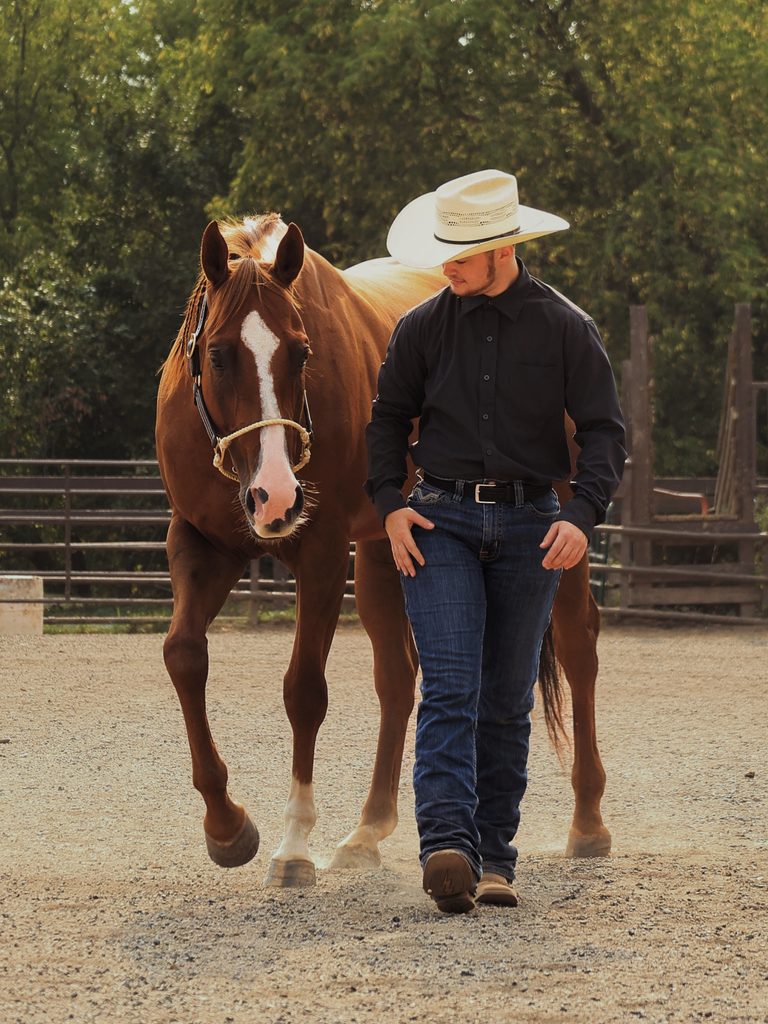
For families with a horse-crazy kid, getting started is easier than many think.
“You don’t have to own a horse to start in equestrian,” Shelia says.
Many lesson barns use school horses, and some even take them to lower-level competitions. Her top advice is to find an NCCP-certified coach and ask lots of questions.
The first purchase is safety gear from a local tack shop: an approved helmet, gloves, boots and, increasingly, a chest protector. An Equestrian Nova Scotia membership costs about $70 a year. Heather says lessons are offered in nearly every corner of the province, and the organization’s website has a guide to getting started and finding a coach.
For young riders thinking about getting started, Ashton keeps it simple: go for it, surround yourself with people who lift you up and stay curious.
“Everybody is still learning,” he says. “As soon as you think you’ve stopped learning, you won’t be able to progress anymore.”